





Advantages and Disadvantages of Crawler Cranes: Exceptional stability on soft ground and the ability to carry loads while moving against difficult transport, soil compaction, and high costs. Consider whether a crawler crane is appropriate for your lifting application.
Strengths of Crawler Cranes: The Crawler Crane Edge
In situations where a project requires both high strength and high accuracy, crawler cranes often have an edge over truck or tower cranes. Here are some of the key advantages of selecting a tracked lifting machine.
1. Superior Stability on Soft Ground
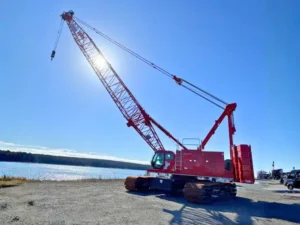
Whereas cranes equipped with rubber wheels tend to work well only when operating on smooth, hard surfaces, crawler cranes are capable of evenly distributing their great weight through their wide metal tracks. In environments ranging from agricultural fields for wind turbine installation to bodies of water for bridges, this trait means that there is no need to construct heavy load distribution pads, which saves time and labor.
2. Ability to Move While Lifting
Standard mobile cranes are certainly capable of hoisting very heavy objects, but their major limitation is that they cannot relocate a suspended load. A standout feature of the crawler crane is its ability to travel with the load still raised. Operators can pick up a component and move it directly to its final position without intermediate set-downs, which greatly improves workflow efficiency for large-scale industrial assembly.
3. No Need for Hydraulic Outriggers
Because of the ample track footprint, the crane will always be able to perform lifting operations without hydraulic outriggers. This means that time does not have to be wasted extending outriggers, which would then require further stabilization. All the operator needs to do is drive to the lifting area, raise or extend the boom, and start the operation. With multi-point lifting requirements, this saves a lot of man-hours.
4. Improved Heavy Lift Capability Using Lattice Booms
Crawler cranes use lattice booms as opposed to telescopic booms employed by other types of cranes. While it may appear archaic compared to the latter, the lattice boom gives the crane an edge in terms of performance. These booms are much more rigid and light compared to telescopic booms. Consequently, the crawler crane is capable of heavy lifts at greater radii. The largest crawler cranes can lift more than 2,500 tons, far more than any wheeled crane.
Crawler Crane Disadvantages
Despite their impressive capabilities, crawler cranes come with several notable drawbacks. These limitations often explain why construction firms choose wheeled alternatives for certain types of work.
1. Complex Transport Logistics
Perhaps the single biggest challenge associated with crawler cranes is moving them between sites. These machines cannot legally or practically travel on public roads. Their metal tracks would quickly damage asphalt surfaces, and their overall dimensions exceed standard roadway width limits.
What this means in practice: Flatbed trucks and additional support vehicles are required to move each major component separately. The crane must be partially disassembled before transport and then reassembled at the new location, adding significant time and cost to every relocation.
2. Low On-Site Travel Speed
Even when operating within a single job site, crawler cranes move at a very slow pace. Their maximum travel speed is typically between 1 and 2 miles per hour (approximately 1.6–3.2 km/h). For projects that require shifting the lifting operation across a large area—for instance, laying a mile-long pipeline—a crawler crane becomes impractical. In comparison, rough-terrain wheeled cranes can move between lift points at speeds up to 15 miles per hour.
3. High Ground Pressure Damage
While crawler cranes perform admirably on soft or uneven ground, the high pressure they exert through their tracks can severely damage finished or delicate surfaces. Using a crawler crane inside a completed concrete underground parking structure, for example, is generally not allowed unless heavy steel plates are first laid down—a measure that increases both expense and preparation time.
4. Assembly and Dismantling Take a Great Deal of Time
While crawler cranes do not need to go through the rigmarole of outrigger setup, they certainly need to go through the rigmarole of boom assembly. This lattice boom comprises several sections that have to be joined together by pins, something that requires an additional helper crane. In large crawler cranes, the dismantling required before transportation takes up to half a day or even more.
5. High Initial Cost and Maintenance Charges
Crawler cranes are initially purchased at a much higher price than many wheeled cranes. Maintenance is also very costly. Track shoes, idlers, and drive sprockets deteriorate faster while operating in rough terrain. Moreover, track replacement costs more money than the replacement of rubber tires in wheeled cranes. Training and licensing are required to use lattice booms and load charts.
Recommendation for Industry
The crawler crane is well-suited for large-scale lifting operations that require the full use of lifting capacity and flexibility. For example, crawler cranes are used for lifting giant bridge beams, placing refinery reactors, or mounting wind turbine nacelles. The capability to move a lifted load together with no outrigger requirement makes the crawler crane the obvious choice for such assembly tasks.
Nevertheless, in cases where there are many small lifts over completed construction ground surfaces or when the crane needs frequent relocation from one urban area to another, the limitations associated with crawler cranes—namely, transportation complications, cumbersome movement at the site, and possible ground damage—could surpass the advantages.
An optimal solution would be to hire crawler cranes exclusively for the heavy-lift operations of the project while using telescopic boom wheeled cranes for other lifting operations.
