





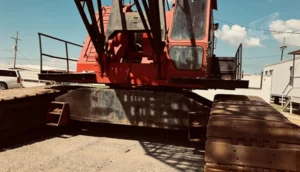
The Link-Belt LS-518 holds a very important place in the history of heavy lifting equipment. Although this 150-ton truss boom crawler crane ceased production in 1988, it remains a common sight on construction sites worldwide. For owners and operators, understanding the machine’s specifications is not only crucial for operational efficiency but also the cornerstone of safety.
Key Specifications
| Specification Category | Detail |
| Rated Capacity | 150 Tons (136,077 kg) |
| Engine (Typical) | Cummins NT855 (245 HP) or Detroit Diesel 8V-71N (246 HP) |
| Standard Boom Length | Ranges from 50 ft to 180 ft (approx. 15m to 55m) |
| Maximum Tip Height | Up to 290 ft with full boom and jib configuration |
| Typical Counterweight | ~90,000 lbs |
| Track Shoe Width | 44 inches (112 cm), providing a low ground pressure of 8.2 psi |
| Transmission Speed | Max 1 mph (2 kph) |
| Year of Manufacture | Produced until 1988, with common models from the mid-1970s to the 1980s |
What to Look for When Buying Used
Since the Link-Belt LS-518 has been discontinued for many years, a thorough inspection is crucial when purchasing it.
- Check Documentation and Certifications
Load Diagram: Ensure a load diagram is affixed to the cab. Without it, the equipment cannot be used safely and compliantly.
Safety Certification Labels: Check for recent safety certification labels on the equipment (e.g., the 2021 label mentioned in the inspection report).
EPA Emissions Label: If you need to transport or register the equipment across regions, be sure to check that the emissions label on the engine is clear. Blurred text may affect subsequent transfers.
- Check Operating Hours
Check the equipment’s hour meter reading. However, for this nearly 50-year-old machine, the hour meter may have been replaced or is malfunctioning; the reading is for reference only.
- Check Engine Condition
Start the engine and listen for any unusual noises. Pay special attention to checking for coolant leaks.
- Assess the Running Gear
Carefully inspect the wear of the track shoes, track rollers, idler rollers, etc. These are core chassis components; severe wear means high replacement costs.
- Perform a load test
Standard on-site inspections typically do not allow for load testing. If you have high-performance requirements for the equipment, you should consider whether it is feasible to conduct a load test before finalizing the contract to verify its lifting capacity.
Conclusion
The Link-Belt LS-518 remains a capable and respected machine in the crane world, a testament to its durable design. However, its age means that operators and owners must be even more diligent about safety. The Link-Belt LS-518 load chart is not just a piece of paper; it is the essential link between the crane’s theoretical design and its practical, safe application on the job site.
