

The question “What is the Purpose of the Crane Idler Gear?” points to a critical component in the world of heavy machinery, particularly in crawler cranes that dominate global construction sites, mines, and infrastructure projects. There’s a component that silently plays an indispensable role in ensuring the crane’s mobility and durability: the crane idler, more commonly known in the industry as the track idler or front idler. This critical undercarriage component is far more than a simple “guide wheel”—it’s a fundamental steering mechanism, tension adjuster, and load distributor for the entire track system. Understanding its purpose, function, and maintenance requirements is crucial for crane operators, maintenance technicians, and project managers to maximize equipment uptime, reduce operating costs, and ensure site safety.
What is a Crane Idler?
In crawler crane terminology, the idler (often called the front idler, guide wheel, or track idler) refers to the large gear or smooth wheel mounted at the front of the crane’s undercarriage, opposite the drive sprocket. Unlike the drive sprocket, which receives power from the crane’s final drive, the idler is a passive, non-powered component that plays several critical roles in the operation of the track system.
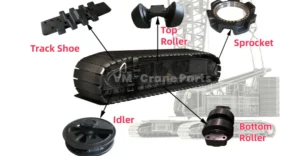
Purpose of the Crane Idler Gear
-
Track Guidance and Direction Control
The most prominent function of the crane idler is to guide the track chain along a precise path within the undercarriage system. By maintaining track alignment, the idler ensures that:
- The track remains properly seated on all support rollers
- Lateral movement (track sway) is minimized during operation
- The crane maintains straight-line travel or controlled turning
- Track pin and bushing wear is even
Engineering Principle: Modern idlers typically feature a flanged design that effectively retains the track chain, preventing derailment when operating under lateral loads or on uneven terrain.
-
Track Tension Adjustment
The idler’s adjustable mounting mechanism is the primary means of controlling track tension. Through hydraulic, screw-type, or shim adjustment systems, operators can:
- Move the idler forward to increase track tension
- Retract the idler backward to decrease tension
- Maintain optimal tension as track components naturally wear
- Compensate for thermal expansion at extreme temperatures
Optimal tension is crucial—too much tension increases rolling resistance and accelerates wear on pins, bushings, and rollers, while insufficient tension causes track “slapping,” damaging components, and reducing efficiency.
-
Undercarriage Load Distribution
During crane operation, the idler bears a significant portion of the machine’s weight, especially when:
- The crane is traversing obstacles or uneven ground
- The load swings towards the front of the machine
- The machine is driving over ramps
- Counterweight stress shifts during lifting operations
By distributing these dynamic loads across its robust bearing system and track frame, the idler prevents excessive stress concentrations on individual track rollers or drive sprockets.
-
Shock Absorption and Vibration Damping
High-quality idlers utilize internal damping mechanisms and precision bearings to:
- Absorb shock loads from uneven terrain
- Reduce vibration transmission to the crane’s superstructure
- Minimize noise pollution in urban operating environments
- Protect sensitive electronic components from vibration damage
Premium Materials and Superior Manufacturing
35SiMn alloy: Provides exceptional yield strength and impact resistance
Precision casting: Offers superior grain structure and fatigue resistance
CNC machining: Bearing surface tolerances controlled to within 0.01mm
Induction hardening: Creates a precisely controlled hardened layer on wear surfaces
Dynamic balancing: Ensures vibration-free operation at all speeds
Bearing and sealing technology: Combines contact and non-contact seals for maximum protection